

If you run a small to mid-sized business (SMB) in the Pacific Northwest—among Seattle’s skyline of cranes, Portland’s bike lanes, or anywhere in between—you know that success here is built on grit, creativity, community—and technology. Tech isn’t just in the background. It’s at the heart of how you operate, grow, stay competitive, and support your people.
Doing business in the PNW comes with its quirks. Employees expect to work from anywhere—whether it’s the office, a mountain cabin, or a coffee shop with “the best roast in town.” Cybersecurity threats and IT challenges can seem more common than cloudy skies. And the region’s mix of booming startups and established industries means competition is always evolving.
So, the real question isn’t just, “Does my small business need IT support?” It’s: “Do I want to spend my time putting out tech fires—or do I want a partner who can keep my systems secure, scalable, and running smoothly during both the literal and figurative storms?” That’s where a Managed Service Provider (MSP) comes in—not as a luxury, but as a must-have for businesses that want to grow without losing their local edge.
Let’s break it down from both a practical, day-to-day view and a broader business value perspective.
What Does an MSP Do Exactly?
At its core, a Managed Service Provider, or MSP, supports the management of your IT environment. This can include:
- 24/7 network monitoring
- Cybersecurity and compliance
- Help desk support
- Backup and disaster recovery
- Hardware lifecycle management
- Vendor coordination
- Cloud services and migration
Rather than relying on internal staff (or worse, scrambling for outside help during an emergency), MSPs deliver a predictable, efficient, and proactive model of IT support.
Day-to-Day: How MSPs Benefit Small Businesses
Where MSPs Shine: Daily SMB Support
- Reduced Downtime; Increased Productivity: With 24/7 monitoring and proactive maintenance, many potential issues are fixed before they can disrupt your team’s productivity, client meetings, or workflows.
- Accessible, Fast Support: Whether an employee is locked out of their system or your cloud file sharing is acting up, a responsive help desk keeps teams efficient and productive while easing frustrations.
- Efficient Tech That Doesn’t Distract: Leadership and staff spend less time worrying about tech and whether or not it’s predictable and safe, and more time focusing on developing business strategy, ensuring KPIs are met, and exceeding your clients’ expectations.
- Scalable Resources: As your business grows, an MSP can quickly adjust services and support levels without requiring the expensive and time-intensive task of internal hiring.
- Access to Multi-Functional Expertise: Partnering with a trusted MSP can certainly offer cost savings compared to hiring an in-house tech, but it also increases your value for spend. Your team will have access to experts across multiple functions, from cybersecurity to telecom solutions, ensuring a holistic, deep and wide approach to IT and security.
The Case for Predictability
For many SMBs, these operational improvements alone justify the cost—but the financial case goes even further. Studies show that unexpected IT downtime costs SMBs an average of $5,600 per minute in lost productivity and revenue, while the average ransomware attack can drain $200,000 from a small business—enough to shutter many for good.
By comparison, an MSP provides predictable monthly pricing that typically comes in at a fraction of the cost of a single major outage or breach. For a West Coast business juggling rising wages, real estate costs, and a competitive talent market, the math is clear: partnering with an MSP isn’t just about convenience, it’s about protecting your bottom line while fueling sustainable growth.

MSPs support operational efficiencies at small businesses that rely on technology.
The Strategic Business Value of MSPs for SMBs
Your MSP shouldn’t just be a tech fix-it shop. They should be your strategic partner. Here’s how the right MSP partner can contribute to your broader business goals:
- Cybersecurity & Risk Reduction: A single breach can expose sensitive client data, trigger costly compliance fines, and damage your reputation. MSPs bring specialized security tools, continuous monitoring, and expert knowledge to help prevent attacks before they happen.
- IT Budget Predictability: Instead of surprise bills when something breaks, you get a predictable monthly cost. That makes it easier to manage budgets and reduce risk.
- Vendor Management: MSPs deal with your internet provider, software vendors, and cloud services, so you don’t have to play the middleman, saving you valuable time and ensuring your technology is right-sized for your organization.
- Technology Planning: Many MSPs provide virtual CIO (vCIO) services, helping you make informed software and hardware investments aligned with your business strategy to ensure the tech you rely on is purpose-built to grow with you and your team.
When an MSP Makes Sense for Small to Mid-Sized Companies
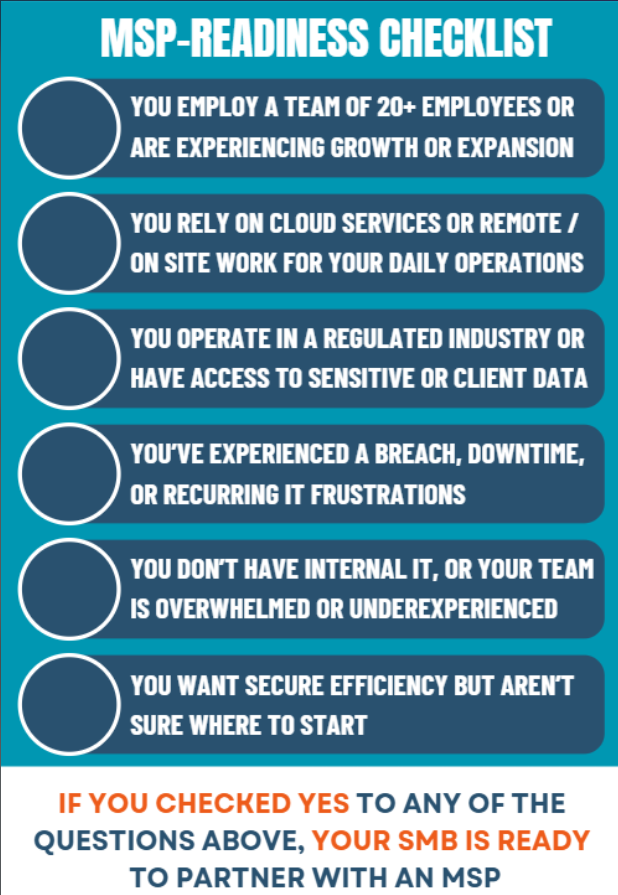
Your small business would likely benefit from partnering with an MSP if you meet any of these criteria:
- You’re growing or hiring: More users = more complexity.
- You rely heavily on cloud services or remote work.
- You operate in a regulated industry.
- You have access to sensitive or client data.
- You’ve experienced downtime, a breach, or recurring IT frustrations.
- You don’t have internal IT or your team is overwhelmed or underexperienced
- You know your team could be more efficient, but aren’t sure where to start
In these cases, the cost of an MSP is rarely an “extra expense”—it’s an investment that pays itself back. Improved productivity means projects move faster, customer deadlines are met, and teams stay focused on their actual jobs instead of troubleshooting laptops. Fewer incidents mean less risk of costly downtime or devastating breaches that could halt operations for days. Reduced compliance risk keeps you out of regulatory hot water (and away from the fines that can come with it). And clearer IT planning means you can finally align technology with your business strategy instead of treating it like a necessary irritation.

One often overlooked benefit of partnering with an MSP is employee job satisfaction. When technology simply works—securely, predictably, and efficiently—teams can focus on hitting their goals instead of battling frustrating systems. This supports productivity and helps reduce turnover.
In fact, replacing an employee can cost anywhere from 0.5 to 2 times their annual salary, depending on role and level—so a 30% reduction in turnover could save your organization tens of thousands of dollars per position. And SMBs with high turnover also experience low morale and lost productivity.
In short: turnover doesn’t just cost SMBs money, it stalls growth, erodes culture, and makes the whole business feel less stable.
The ROI of Managed IT for West Coast Small Businesses
The ROI of managed IT support is especially compelling for West Coast businesses.
Construction firms lose an average of $4,500 per hour of downtime. An MSP’s proactive monitoring can slash those losses by preventing system failures before they stall a job site.
In healthcare, compliance penalties for HIPAA violations can reach $50,000 per incident, making MSP-managed security and data protection a bargain by comparison.
Manufacturers and logistics providers across the I-5 corridor face razor-thin margins where every minute counts; MSP-supported networks have been shown to reduce downtime by up to 85%, protecting both output and revenue.
For professional services firms, MSPs often deliver a 25–45% reduction in IT costs and over a 50% increase in competency compared to staffing in-house, while giving leadership back hundreds of hours per year that would otherwise be lost to IT headaches.

MSPs support SMBs in regulated industries, from legal and financial firms, to healthcare offices and construction companies.
For Pacific Northwest leaders, the math adds up. It would not be unusual for a small business with 25 employees in a regulated industry to see an ROI of upwards of $200,000–$350,000 per year by partnering with the right MSP—turning technology from a constant risk into a strategic advantage. Partnering with an MSP doesn’t just protect your systems, it protects your margins, your reputation, and your ability to grow with confidence in one of the most competitive regions in the country.
When an MSP Might Not Be Necessary for a Small Business
In the spirit of transparency, not every small business may need a managed service provider or dedicated IT support.
- Few or No Employees: If you’re a two- or three-person firm using only basic cloud tools (e.g., Google Workspace or Microsoft 365), and your risk exposure is low, you might not need full-scale managed support. In that case, occasional consulting or pay-as-you-go IT services may be more appropriate.
- Low Tech Complexity: Some businesses operate with minimal technology needs and no sensitive data. If that sounds like you, an MSP might be overkill—at least for now.
However, even these businesses should still consider basic security measures and backups, which some MSPs offer in affordable, scaled-down plans. Don’t let your size fool you into believing the myth that small businesses don’t need cybersecurity.
Industry Spotlight: Why Managed IT Matters More in Certain Sectors

Construction
Jobsite connectivity, mobile device support, and coordination across contractors means downtime can quickly derail timelines. An MSP ensures uptime, standardizes systems, and helps secure project data.

Manufacturing
From ERP systems to connected equipment, manufacturers need reliable uptime and strong cybersecurity. MSPs help protect IP, minimize disruptions, and meet industry compliance standards.

Professional Services
Firms like law, accounting, healthcare, or consulting depend on client data, speed, and professionalism. An MSP helps ensure systems are secure, software is updated, and nothing gets in the way of delivering value.
What Does Managed IT Support for SMBs Cost?
Pricing varies based on your needs and business size, but most SMBs can expect:
- Per-user or per-device pricing: Common for businesses with remote or hybrid teams.
- Flat-rate monthly packages: Includes help desk, monitoring, and patching.
- Tiered service levels: Choose between essential services or full vCIO and strategic planning.
While it’s tempting to focus on price alone, businesses looking to future-proof their growth path will assess value in terms of risk avoided, time saved, and potential for growth.
So, Is an MSP a Necessity or a Nice-to-Have?
Here’s the bottom line:
Must Have: If your business is growing, working with sensitive data, or relies on technology to stay competitive, an MSP is likely a necessity.
Nice to Have: If your business is very small, low-tech, and risk-tolerant, managed support may be a nice-to-have—but still valuable for specific needs.
Think of it like insurance and infrastructure rolled into one. You don’t realize how important it is until something breaks—but if you’re working with a good MSP, that “something” might never break in the first place.
Finding the Right MSP for Your West Coast SMB
The right MSP will align with your industry, budget, and business goals. Look for one that:
- Offers clear, predictable service plans
- Communicates proactively and transparently
- Understands your industry-specific needs
- Prioritizes long-term partnerships, not just quick fixes
Ready to Explore Your Options?
If your business relies on technology (and let’s face it, most do), it may be time to talk with a managed IT support provider. A quick conversation could reveal vulnerabilities, inefficiencies, or opportunities you didn’t know existed.
Unleashing operational efficiency, growth, and resilience through Security-First IT
Managed IT isn’t just about fixing computers—it’s about enabling and accelerating business growth. SMBs that embrace a security-first, strategic approach to IT are proven to be better positioned to reduce costs, increase uptime, and scale securely in a digital-first economy.
OLS transforms your technology from a constant risk to a strategic advantage. The result is more than daily support—it’s a foundation for resilient growth, backed by predictable costs to make an uncertain future a little more certain.
Ready to see how IT can drive your growth? Reach out to OLS today for a strategic IT assessment.
Predictable. Efficient. Safe. IT that’s more than tech—it’s fuel for growth.
OLS Technology helps Pacific Northwest SMBs grow with managed IT and cybersecurity built for the real world. We focus on what matters most to your teams and your bottom line: predictable pricing, reliable tech and uptime, smarter workflows, and secure data and communication.